
Informazioni base
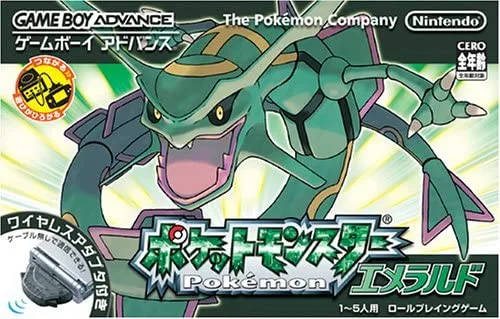
Pokémon Emerald
- Data di uscita
- Sviluppatore
- Game Freak
- Piattaforme
- GBA
Informazioni base
"Pokémon Emerald" (Japanese: ポケットモンスター エメラルド, English: Pokémon Emerald), with Rayquaza on the cover, is the twelfth game in the Pokémon series in Japan, and the eleventh in Europe and North America. "Pokémon Emerald" is an updated version of "Pokémon Ruby and Sapphire". It was released in Japan on September 16, 2004, in North America on May 1, 2005, in Australia on June 9, and in Europe on October 21.
Based on "Pokémon Ruby and Sapphire", this game adds some new elements, and the plot is also slightly modified: Magma and Ocean are both villain groups and they fight endlessly, and they awaken Groudon and Kyogre respectively. The two mythical beasts start a fierce battle, causing severe weather anomalies in the Fengyuan area. Players must awaken the third mythical beast, the Pokémon on the cover, Rayquaza, to quell the dispute between Groudon and Kyogre. There have also been some changes to the system functions. Although doubles battles have been introduced in "Pokémon Ruby and Sapphire", in Emerald, two seemingly separate non-player characters on the map may be triggered at the same time to start a doubles battle when the player walks to a certain location. After defeating the four kings, the player can also call the gym leader of each gym through the prop "Pokémon Navigator" and fight them again in doubles battle mode. The image of Pokémon in battle is changed to an animated mode like the crystal version. The biggest update should be the addition of the "Battle Development Zone", which is an expanded version of the battle tower. After defeating the four kings, players can go to this zone to experience various facilities with different battle modes.
Another change in the plot is the addition of the magma base on top of Chimney Peak, which is also where players first discovered Groudon in the Emerald version. "Pokémon Emerald" has added a new non-player character named Ashida (エニシダ). He is the developer of the "Battle Development Zone". He will pay attention to the protagonist's growth in the game and continue to be in contact with the protagonist. After the protagonist defeats the four kings, he invites the protagonist to the zone.
Pokémon "Emerald" received good reviews after its release[65][66]. GameSpot gave it a score of 7.5 out of 10[67], IGN gave it an "impressive" 8 out of 10[64], and the review aggregation website GameRankings rated it a 77. %[68], however, Eurogamer only gave the game 6 out of 10 points. Although it praised the game for looking better than the Ruby and Sapphire versions and having higher playability and challenge, it criticized the game for not even being half as updated as Ruby and Sapphire, and being just a "Ruby/Sapphire director's cut." "Pokémon Emerald" was the second best-selling game in the United States in 2005. A total of 6.32 million copies were sold, making it the third-highest-selling game in GBA history, second only to "Pokémon Ruby and Sapphire" and "Pokémon FireRed and LeafGreen"[70]. In November 2005, Nintendo Power incorrectly reported that "total sales of Pokémon Emerald will exceed the value of an emerald the size of Neptune."
Articoli correlati
Non ci sono ancora articoli sui giochi.